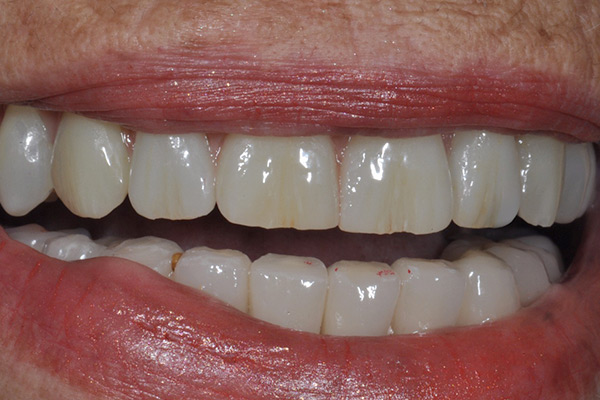
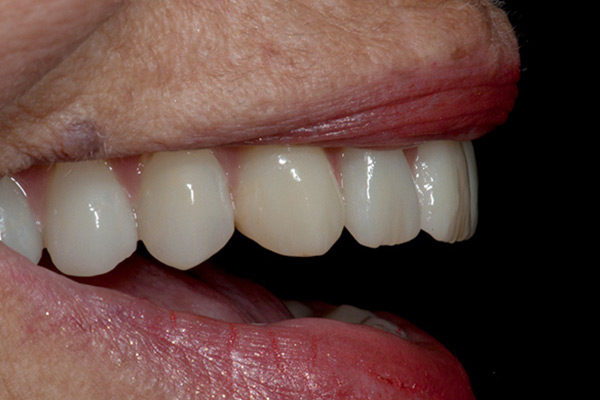
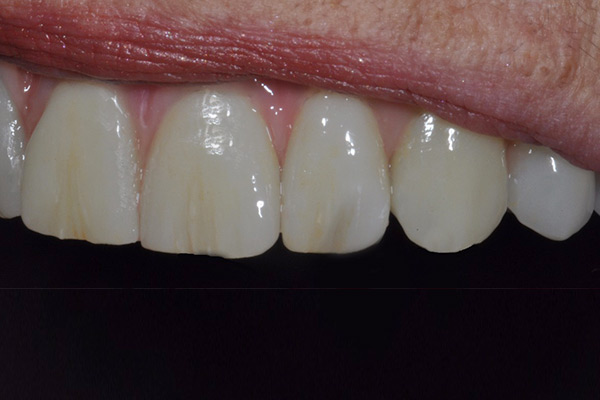
Un caso di edentulia mascellare con sette impianti è la situazione iniziale della restaurazione descritta. Per questo caso abbiamo optato per una ricostruzione avvitata (Toronto Bridge) composto da una struttura in titanio monconizzata e una serie di corone singole in zirconia Anterior Zirkonzahn. L’anatomia gengivale è stata stratificata con composito gengivale.
Sulla base della situazione implantare digitalizzata, abbiamo virtualmente modellato il framework di titanio, che è stato successivamente fresata con l'unità di fresatura Wet Heavy Metal M1 usando la funzione di lavorazione a umido. Per mascherare la struttura del titanio sotto le corone in zirconia, abbiamo ridotto il suo valore grigio usando l’opaco composito della shofu. La struttura in titanio è stata rivestita in colore b3 per le zone dei monconi e in rosa per le parti gengivali. Un doppio colore rende l’aspetto delle gengive e dei denti, più naturale. Successivamente abbiamo fatto la scansione della struttura così colorata. Basandoci sui dati digitali precedenti, abbiamo creato le corone usando la libreria virtuale Aida (Natural Morphology) di Heroes collection. Abbiamo fresato la zirconia Anterior con il fresatore M5 Zirkonzahn. Dopo la fresatura, abbiamo verniciato e smaltato le corone di zirconio a tutto contorno con colore di ghiaccio 3D. Infine, abbiamo cementato le corone sulla struttura del titanio. Il restauro è stato poi completato stratificando la parte gengivale, utilizzando la gengiva composita.
A case of an edentulous maxilla with seven implants was the initial situation described for the restoration. For this case, we decided to create a Toronto Bridge composed of Anterior single crowns cemented on a titanium framework with stumps. The anatomy of the gingiva was layered using Gingiva-Composites. Based on the DIGITISED implant situation, we virtually modeled the titanium framework, Which Was subsequently milled with the M1 Wet Heavy Metal milling unit using the wet processing function. In order to mask the titanium structure under the zirconia crowns, we reduced its gray value using the shofu composite opaque. The titanium structure was covered in A2 color for the stump areas and in pink for the gingival parts. A dual color gives the gingiva and the teeth, more natural color. Subsequently, we scanned the metal substructure. Based on the digital data, we then created the crowns using the AIDA natural morphology from the Heroes Collection virtual tooth library. We milled the Zirkonzahn Anterior crowns with M5 millin unit Zirkonzahn. After milling, we painted and glased the full-contour zirconia crowns with 3d Ice color Finally, we cemented the crowns on the titanium structure. The restoration was then completed by layering the gingival part, using the composite gingiva.